Introduction
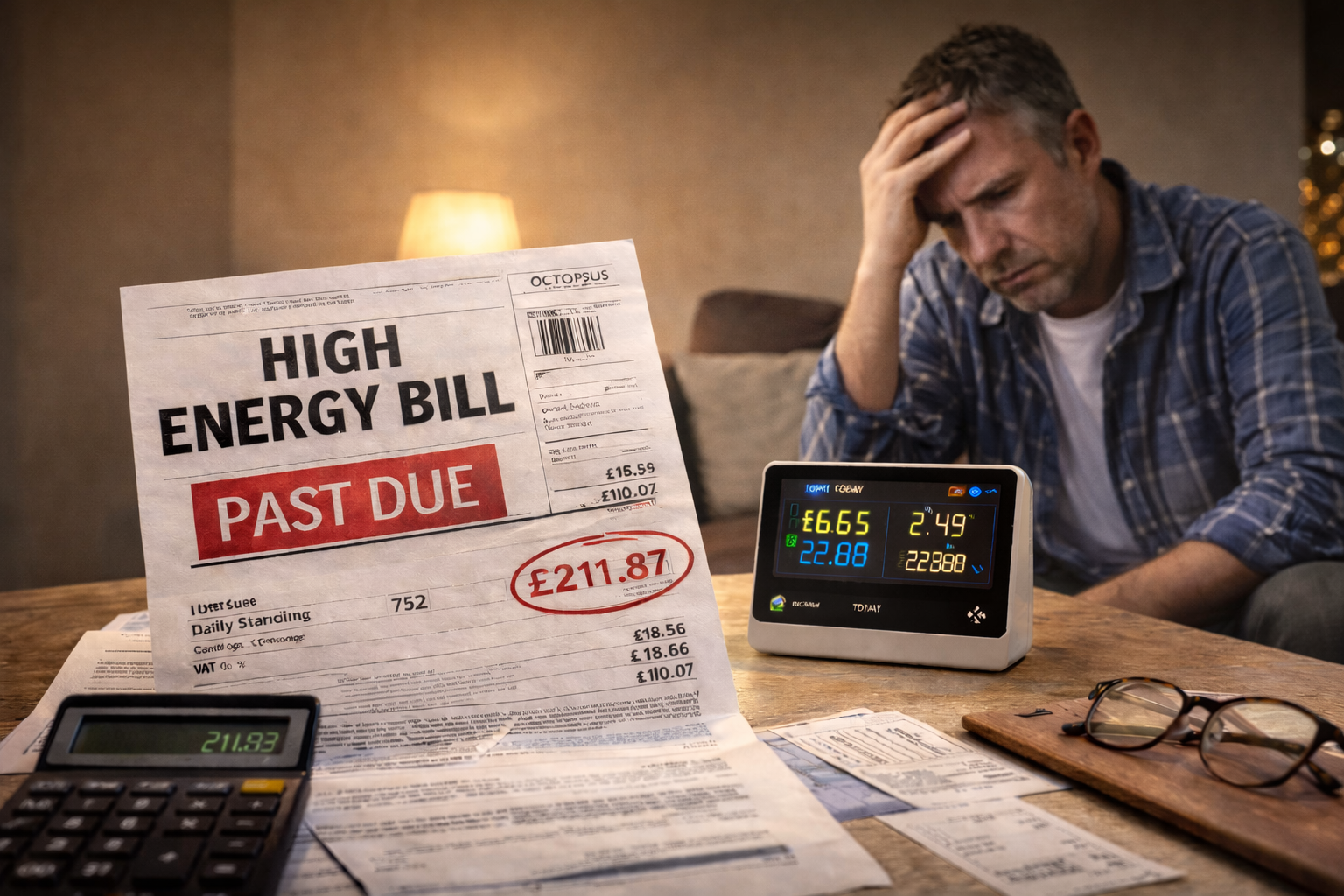
With 4 of us in a new home, our electricity bill sky-rocketed to over £200 a month. Heating a tank of hot water alone could account for up to half of our daily electricity usage and cost over £3 per day just for hot water (sometimes just for my teen’s long shower…).
Context
We moved into our current home in spring 2024. With our electricity supplied by Octopus Energy through a fixed tariff of 23.86p/kWh and a daily standing charge of 61.88p/day, our new normal daily electricity consumption averaged around 25kWh which is 750kWh a month and 9,000kWh annually. Each month, this cost us around £207 including standing charge and VAT.
As a family of 2 adults and 2 children, 750kWh of electricity per month was a staggering 2-3 times the UK average based upon official figures provided by the Department for Energy Security and Net Zero and Ofgem. They say a typical family of four in the UK uses around 3,200 to 4,500 kWh of electricity per year or 8-12kWh daily.
We didn’t own an EV which is typically what a high-usage household might see as their biggest consumer of electricity. So what was causing our high demand?

The Past Came Back to Haunt
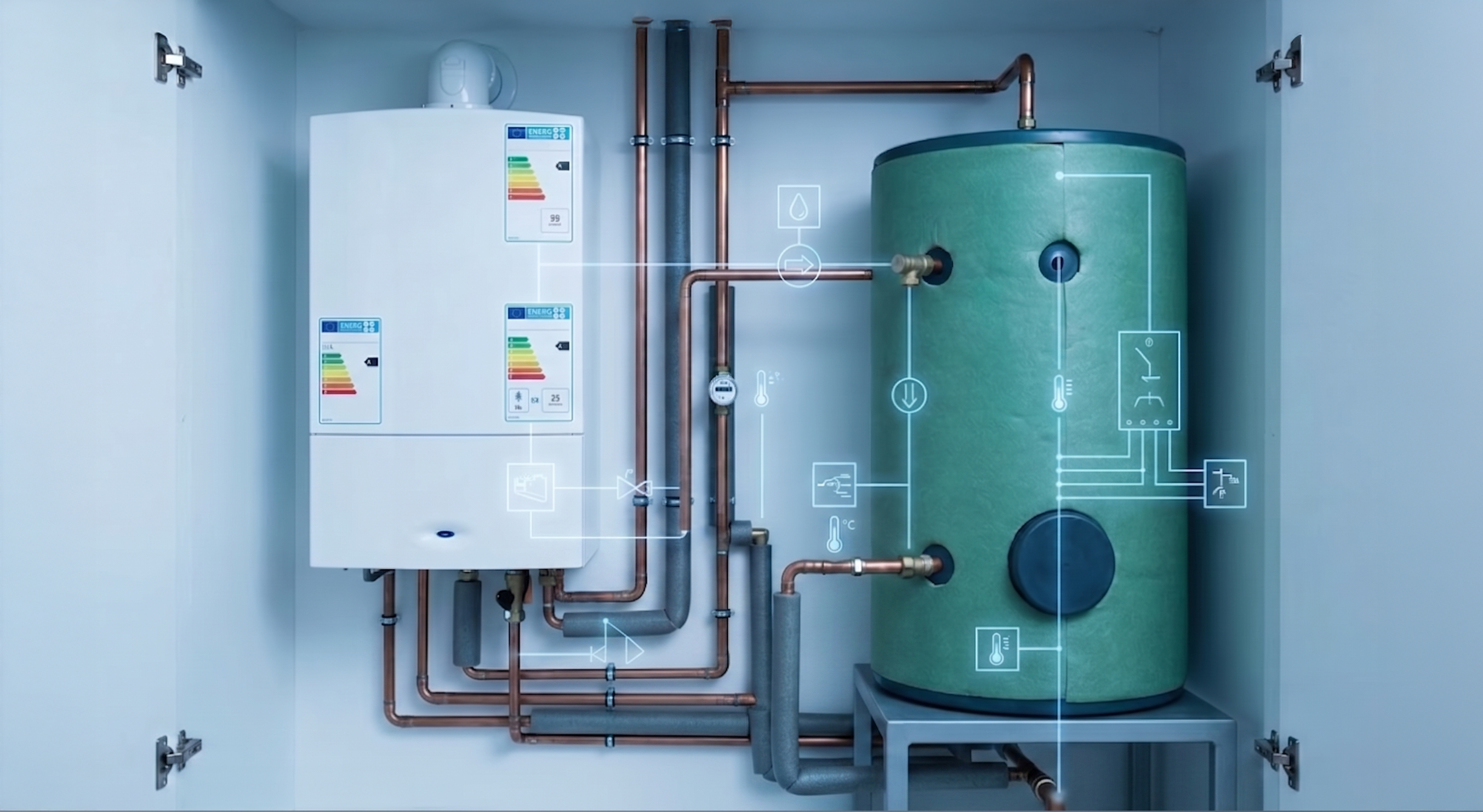
Previous owners of our house had made a decision to install a 210-litre hot water storage tank which could only be heated by a built-in immersion element. The house had a gas boiler, but only the central heating radiators were plumbed into it.
The bathrooms had rainfall showers fitted which have a high flow rate meaning anybody taking an extra long, hot shower was likely to use up all the hot water. The water bill is also much higher than typical, but that’s a separate topic.
For a 210L hot water cylinder and 3kW-rated immersion heater, it takes between 12-14kWh of electricity over 4-4.5 hours to get it to 55-60°C from 5-10°C. That’s half of our daily electricity demand just for one tank of hot water from cold.
The central heating was the only use of gas within the household. We had electric ovens and induction hob for cooking. Add in the dishwasher, fridge, freezer, washing machine, tumble dryer, TV, personal devices, WiFi, etc and we arrive at an average of 25kWh per day.
With the cost of electricity ever-increasing and our own consumption only ever likely to increase, we knew something had to change to reduce our electricity bill.
Options on the Table
Tackling the hot water situation was the most obvious single thing we could do since it made up around half of our electricity usage. The main options considered at the time were:
- Replace the hot water cylinder with one which can be heated by the gas boiler and have the necessary plumbing installed. ~85–90% efficient. Cost estimated at £3.5k.
- Replace the hot water cylinder with one which can be heated by an air source (to water) heat pump and plumb them together. ~2.5–3.0 coefficient of performance (CoP). Cost estimated at £5k including government BUS grant of £7.5k.
- Keep the existing hot water cylinder, install solar panels to generate electricity and a storage battery for when generation drops. Cost estimated at £10k+.
For hot water alone, plumbing the hot water cylinder to the gas boiler was the most direct and cost effective option, but the benefits would have been limited to just making hot water cheaper to produce. The other two options could reduce the cost of heating water as well as heating the house or generating electricity for other uses.
Another consideration was that the gas boiler was over 10 years old. There were signs the previous owners hadn’t maintained the boiler, but we’d had it serviced and some minor issues repaired. The boiler was from a reputable brand and was otherwise working well, but could need replacing in the next few years.
Longer Term Considerations
We’d been interested in solar energy for a while and knew of others who’d had a system installed. For our own household, adding renewable energy into the mix was something we’d already considered with the electrification of our home heating and cars. So, this was an opportunity to make a real start on that journey.
Our increasing reliance upon electricity and the external factors influencing the cost of supply meant that gaining some independence from the grid was becoming an important requirement.
For me, I was tired of being increasingly exposed to rising energy costs so this was a way to regain some control.

Running Costs
To be honest, we didn’t do a deep dive into what the ongoing running costs for each option were likely to be. It felt like plumbing the gas boiler and water cylinder wasn’t the direction we wanted to take. The heat pump still seemed risky based upon our research with some people suggesting it wasn’t very effective whilst others said it worked well.
Solar and battery felt like the better choice overall due to the energy independence it offered and, spoiler alert, was what we chose, but let’s take a look at what the cost to heat up one tank of water would be for each option for comparison.
Current gas and electricity tariff
At the time, our gas and electricity was supplied by Octopus on their fixed tariffs. For the plumbing only option, we would have stayed on these or an equivalent with another supplier. For the heat pump and solar options, other tariffs become more suitable.
| Option | Hot Water Cost (210L) | Efficiency |
|---|---|---|
| Immersion heater | £3.34 | 100% |
| Gas boiler | £1.00 | 85–90% |
| Air source heat pump | £0.69 | 3-400% |
| Battery on Flux tariff | £2.40 | 100% |
Gas & Plumbing option
Replacing the cylinder and plumbing it the boiler would shift our water heating to gas and slightly reduce the efficiency from near 100% down to 85-90%, but the cost of gas per kWh was and still is about a quarter of that for electricity.
On the fixed tariffs, electricity was a flat rate of 23.86p/kWh with a standing charge of 61.88p/day. Gas was a flat rate of 5.44p/kWh with a standing charge of 28.41p/day which means it would cost £1 to heat up the tank of water.
That’s a significant saving which could pay for itself within 2-4 years, but it did mean we’d still pay both sets of standing charges and the remaining 12kWh of electricity for other uses would be an additional £2.86.
Heat pump option
Replacing the cylinder, installing an air source heat pump, and all the necessary plumbing would maintain electricity as the means to heat water. It would also move the home heating from gas to electricity, remove the gas standing charge if we disconnected completely, and multiply the efficiency we got from our energy expenditure.
Assuming a CoP of 3, approx. 4.5kWh of electricity would be used to heat up the hot water cylinder with 12-15kWh of heat energy. Using the current (spring 2026) Octopus Cosy tariff rate of 15.35p / kWh for heat pumps brings the cost of a full tank of hot water to just 69p. The remaining 12kWh of electricity for other uses would be an additional £4.19 at a day rate of 34.94p / kWh.
Solar PV and battery option
The third option, to install solar PV panels (11 x 445W panels) and a home battery (Tesla Powerwall 3), was by far the most expensive up front, but then we’d get “free” electricity from solar generation and cheaper electricity from overnight charging from the grid with a time of use tariff.
The tariff we would start with would be Octopus Flux for import and export. As of spring 2025, these offered 3 different rates for electricity through the day.
| Rate Type | Import | Export |
|---|---|---|
| Day rate | 28.5p / kWh | 10.54p / kWh |
| Flux (02:00-05:00) | 17.1p / kWh | 5.12p / kWh |
| Peak (16:00-19:00) | 39.9p / kWh | 30.68p / kWh |
| Standing charge | 67.83p / day | - |
The calculation to work out how much it would cost to heat up a tank of water wasn’t straightforward on Flux as our immersion heater would require 4-4.5 hours to heat up the full 210L to 55-60°C. With only a 3-hour overnight off-peak window, we’d still need another 1-1.5 hours and 3-4kWh electricity outside of the off-peak window to finish heating the water.
With a large enough battery charged up from the grid during the off-peak window the additional 3-4kWh would also be at that rate. So, the 12-14kWh for a tank of hot water would cost £2.05 - £2.40 (ex. VAT) and the remainder of our 11-13kWh usage could cost £2.37 - £4.13 (ex. VAT) coming from a mix of what’s left in the battery and importing from the grid at the day rate.
If we did some load shifting to move things such as a dishwasher load to the cheaper off-peak window then we’d reduce costs further.
Of course, this is not including any electricity we’d generate from the solar panels which would vary greatly depending on the season. In the middle of winter, we’d be looking at generating anything between 0.1kWh to 5kWh a day. In summer, we could reach a peak of 30kWh which we could either use or sell back to the grid.
Comparing the Numbers
For the purpose of this comparison, I thought I’d take the worst case scenario in the middle of winter with very little solar generation.
| Option | Install Cost | Standing (daily) | HW Cost | Other Elec | Total Daily | Monthly |
|---|---|---|---|---|---|---|
| Existing | £0 | Gas + Elec (~£1.00 - £1.20) | £2.86 - £3.34 | £2.86 | £5.72 - £6.20 | £171.60 - £186 |
| 1. Gas cylinder + boiler (fixed tariff) | £1,800 - £3,500 | Gas + Elec (~£1.00 - £1.20) | £1.00 | £2.86 | £3.86 | £115.80 |
| 2. Heat pump (Cosy tariff) | £3,000 - £6,000 | Elec only (~£0.50 - £0.75) | £0.69 | £4.19 | £4.88 | £146.40 |
| 3. Solar + battery (Flux tariff) | £10,000 - £18,000 | Gas + Elec (~£1.00 - £1.20) | £2.05 - £2.40 | £2.37 - £4.13 | £4.42 - £6.53 | £132.60 - £195.90 |
As solar generation varies across the year, it’s difficult to show a typical day or month because what you’ll get depends on which month you’re in. In the table above, I’ve put the worst case scenario for the solar option; this is mid-winter with negligible solar generation. In that scenario, you can see that the solar and battery set-up shown is actually more expensive than not doing anything at all!
Just to be clear that this is on the basis of no solar generation at all which even in December/January is highly unlikely. It’s also on the Octopus Flux tariff which, arguably, isn’t a good winter tariff for solar and battery set-ups.
We’ll see further on, the difference being on an appropriate tariff can make.
Decision Made
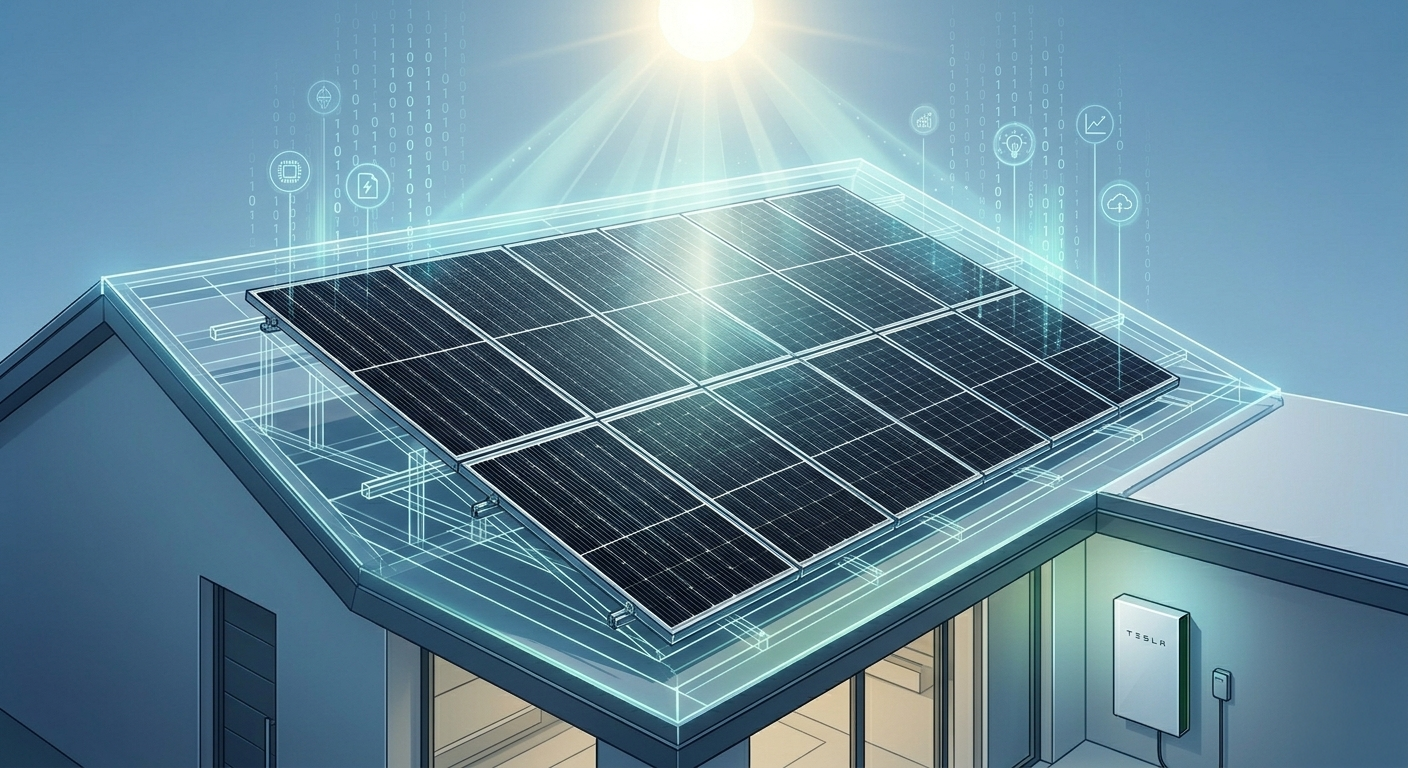
The appeal of becoming more energy independent was strong as was the idea of both reducing the amount of electricity we imported and the unit cost we paid for it. So, we chose to invest in a solar PV and home battery solution which comprised 11 x 445W panels and a Tesla Powerwall 3.
The Powerwall 3 is a premium option and we could have saved a few £thousands by opting for a cheaper brand, but we wanted an outdoor installation, the features were good, and going with an established brand provided reassurance.
We chose Octopus Energy as our installer, again, going with a trusted brand for such a large investment felt like the right thing to do. The installation had a few hiccups along the way and we appreciated being able to deal with a professional team who returned our calls and answered our emails.
If we did it again or were to ever expand our system then with some experience behind us we would consider independent installers.
How Has the System Performed?
Our first full month with the solar and battery system was April 2025 although it took a few weeks to get the export tariff set up. With the benefit of the sunniest April in recent years, we saw our monthly bill drop by a massive 45% compared to the year prior. That was a real world saving of almost £80 from £174 to £97.
Spring turned to summer and the savings kept increasing. Our best month was in June when we saw plenty of solar generation and a generous export rate between 4-7pm meant that our bill was reduced by 73% from June 2024.
We were generating so much that we didn’t feel the impact of having to import in the evening until we turned a corner in September. The drop-off in solar generation, only having enough battery capacity to meet 50% of our daily demand meant we were increasingly importing from the grid in the evenings.
By October, it was clear we had to get off the Flux tariff and that doubling our battery capacity to 27kWh would protect us from expensive imports from the grid.
In November 2025, we installed a Tesla DC Expansion Pack which gave us a total of 27kWh of battery storage and we changed energy supplier to Good Energy. We still didn’t have an EV, but Good Energy were allowing non-EV owners onto the their EV tariff.
These two things made a huge difference to our bill. With 5 hours of off-peak at a rate of 6.6p / kWh, we’ve been able to fully charge the 27kWh of battery storage overnight, heat up a full tank of water, run some shifted loads of dishwashing and laundry all for less than £3 daily.
Having enough battery capacity to cover our daily needs has allowed us to not need any peak import from the grid. The increasing solar generation has meant we’re able to export much of it whilst still maintaining a relatively full battery.
It will be interesting to see if we can achieve any months at net zero or be in credit with our electricity bill. Being able to stay on an EV tariff will be an important part of being able to achieve this.
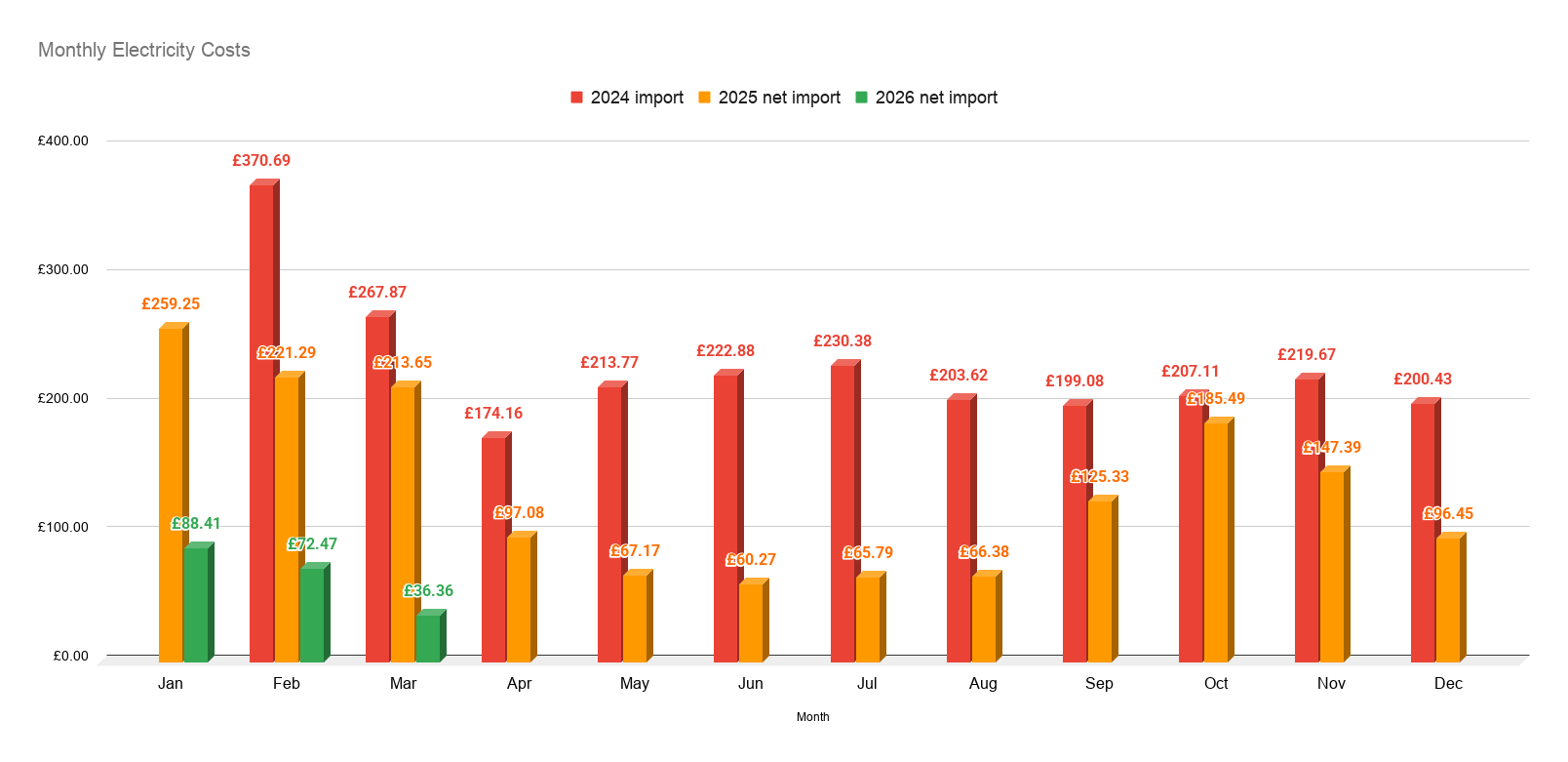
Data note: 2024 and 2025 show full-year data. 2026 data reflects January - March only. Click graph to enlarge.
The Financials
Common questions asked are “what’s the payback period?” and “would it have made more money if the system cost had been invested in the stock market?”
The cost for the initial installation of solar panels and Powerwall 3 was £13.2k. The cost for the DC Expansion Pack was £4.8k. Total system cost, £18k.
Assuming we can stay on an EV tariff to maintain low-cost charging overnight to sustain the current pattern then we are looking at a payback period of around 8-10 years, taking inflation into account.
The panels and batteries have warranties which extend far beyond the payback period so we ought to have many more years of pure profit.
Whether the £18k would have been better invested in the stock market requires a nuanced response. Stock market returns aren’t guaranteed and usually take time to compound. What’s almost a certainty is that somebody choosing the investment route will still be paying ever-increasing utility bills.
A solar PV and battery system, on the other hand, offers immediate savings and is inflation linked. Any savings made can then be invested, if so wished.
It’s a similar question to whether you’d feel better about paying off your mortgage or investing the money instead. Possibly, the stock market will provide greater returns, but how does that compare to the peace of mind you get knowing you have security in your home.
👉 Try the Solar ROI Calculator for yourself.
TL;DR
- Monthly electricity bill: £200+.
- Largest drain: Immersion heater in 210L hot water cylinder.
- Biggest win: Solar and 27kWh battery capacity and EV tariff (even without an EV).
- New lowest monthly electricity bill: < £40.
- System cost: £18,000.
- Payback: 8-10 years.