What Happens to Your Solar Panels in a Power Cut?
When the power goes out, most households quickly discover which things they truly depend on. What people typically worry about is the boiler losing power mid-winter, the fridge and freezer starting to warm up, the broadband router going offline, and the electric vehicle sitting on the driveway with 20 miles of range. For households with medical equipment or an air source heat pump or perhaps no secondary means of heating, the stakes are higher still.
Most standard solar installations offer no protection against grid outages despite having the means to generate electricity. Understanding why this is and what it would take to be able to make use of your generated electricity is worth knowing whether you’ve already got solar or are still in the planning stages.
How Common Are Power Cuts in the UK?
Before worrying too much, it helps to put the risk in perspective. According to Ofgem data, the average UK household experiences around 0.4 unplanned outages per year, losing electricity for roughly 38 minutes per home. This equates to about four power cuts per decade. Planned interruptions for maintenance occur around once every two and a half years and last around 95 minutes on average.
Experience varies by region, with rural Scotland and parts of southern England seeing roughly twice as many outages as those in north-west England. Occasional larger events, such as the August 2019 blackout that cut power to 1.15 million customers after lightning took two major power stations offline simultaneously, are a reminder that unexpected disruptions do happen.
For most households, a power cut is a short inconvenience. For others, particularly those with medical equipment, young children, or homes that rely heavily on electric heating, the impact is considerably more serious.
Why Solar Shuts Down in a Power Cut
Almost all UK home solar installations are grid-tied systems. Your panels generate DC electricity, your inverter converts it from DC to AC, and any surplus goes out to the grid in exchange for Smart Export Guarantee (SEG) payments.
That grid connection is the issue. When the grid fails, engineers from your Distribution Network Operator (DNO) go out to investigate and make repairs. If your solar system kept generating and pushing electricity onto the network, those engineers could encounter live wires they don’t expect with potentially fatal consequences.
To prevent this, every grid-tied solar inverter is required to detect when the grid goes down and shut itself off immediately. This is called anti-islanding protection, and it is a legal requirement in the UK. Your panels don’t stop absorbing sunlight, the physics keeps happening on the roof, but with no approved path to deliver that electricity into your home safely, the system simply stops producing usable power.
This isn’t a flaw in your installation. It’s a safety feature working exactly as designed.
Does Having a Battery Change Things?
This is where it gets more nuanced because the answer depends on the type of battery system you have and how it was installed.
Most standard battery systems also shut down in a power cut. A battery connected to a standard grid-tied inverter to store surplus solar and reduce your bills will, in most cases, cut out when the grid fails for exactly the same anti-islanding reasons. This catches a lot of homeowners off-guard who assumed that having a battery automatically meant having backup power. It does not.
Hybrid inverter systems with EPS capability are different. A growing number of modern battery systems include a feature called Emergency Power Supply (EPS) or island mode. When these systems detect a grid failure, they disconnect your home from the grid, isolate your property electrically, continue supplying power from the battery and from your solar panels if the sun is out. The transition typically happens in milliseconds, sometimes fast enough that computers don’t reboot and broadband routers stay connected.
Having a hybrid inverter is not enough on its own. EPS capability requires physical wiring with a dedicated earth, not just a software setting. Either a dedicated backup socket, a sub-board for specific circuits, or a whole-house changeover switch. This is why it’s essential to specify backup power requirements before installation rather than trying to add it afterwards.
Which Systems Actually Deliver Backup Power?
Two systems currently stand out in the UK market.
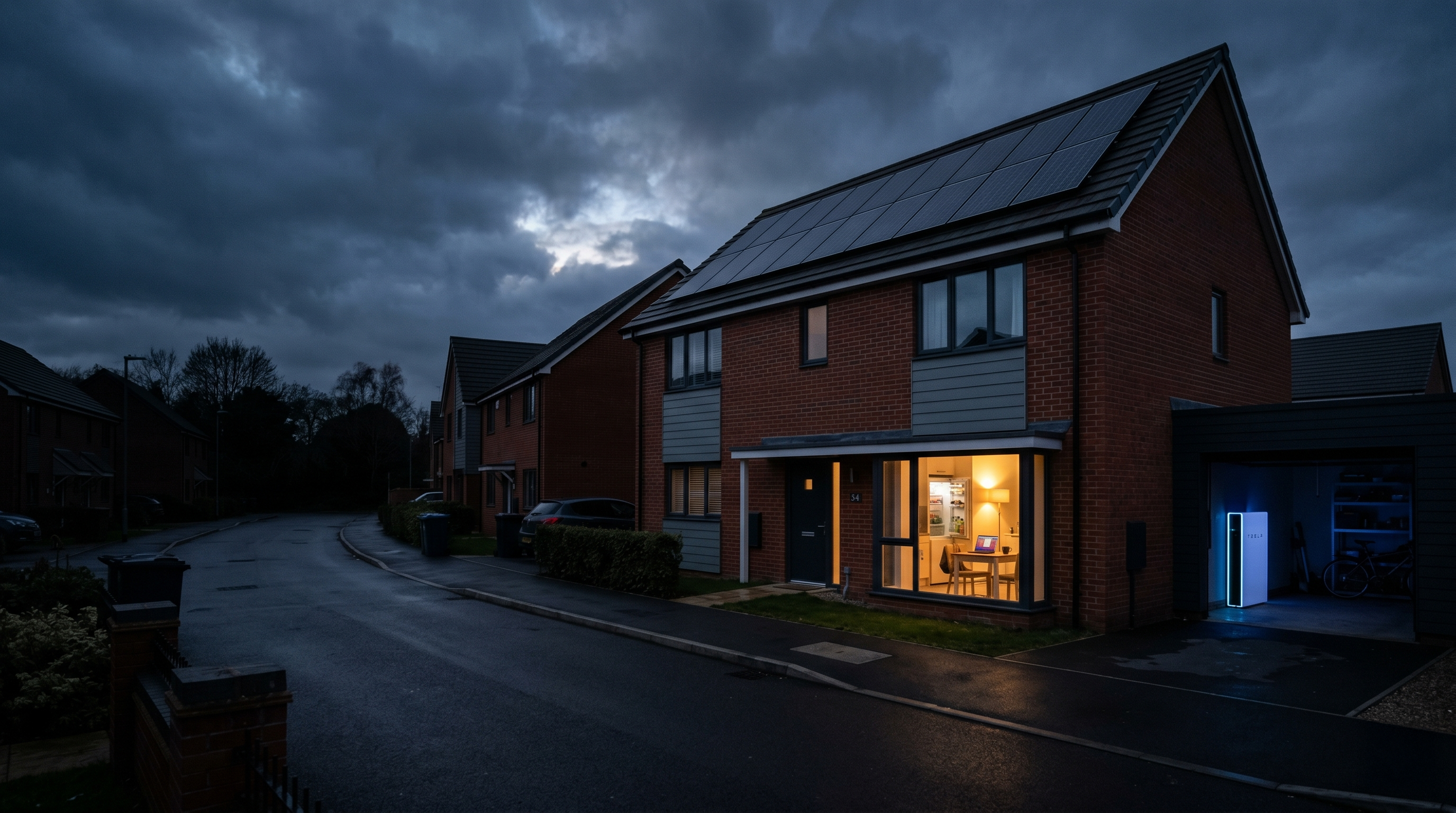
Tesla Powerwall 3 remains the most widely known whole-home backup solution. Together with the Tesla Backup Gateway 2, it disconnects from the grid automatically during an outage and switches into backup mode almost instantly. With a continuous output of 11.04kW of its 13.5kWh capacity, it can run most household circuits simultaneously and continues charging from your solar panels during the outage. This means a daytime cut on a sunny day may barely dent the battery at all.
For EV owners, the Tesla Wall Connector integrates with the Powerwall 3 to charge your car from stored solar or cheap overnight electricity under normal operation. During a power cut, whether EV charging continues depends on your system configuration and the load capacity available. it is possible, but worth confirming with your installer at the design stage rather than assuming it.
Sigenergy SigenStor is a newer and increasingly popular alternative. It’s a modular all-in-one system combining a hybrid inverter, battery storage, and energy management in a single stackable unit. With the optional Sigen Energy Gateway, it offers whole-home backup with a claimed 0ms switchover time, meaning sensitive electronics don’t notice the transition. The Gateway supports both single-phase and three-phase supplies and includes six smart load ports, so you can prioritise which circuits stay protected during an outage. Like the Powerwall 3, it can continue generating solar power during a cut rather than drawing solely from stored battery reserves.
Where the SigenStor differentiates itself for EV owners is its optional DC charging module, which can deliver up to 25kW directly from solar and battery and continues operating during a power cut. That makes it a meaningfully stronger option for households where keeping an EV charged through an outage is a priority.
Both systems use lithium iron phosphate (LFP) battery chemistry and carry 10-year manufacturer warranties.
What Can You Realistically Run?
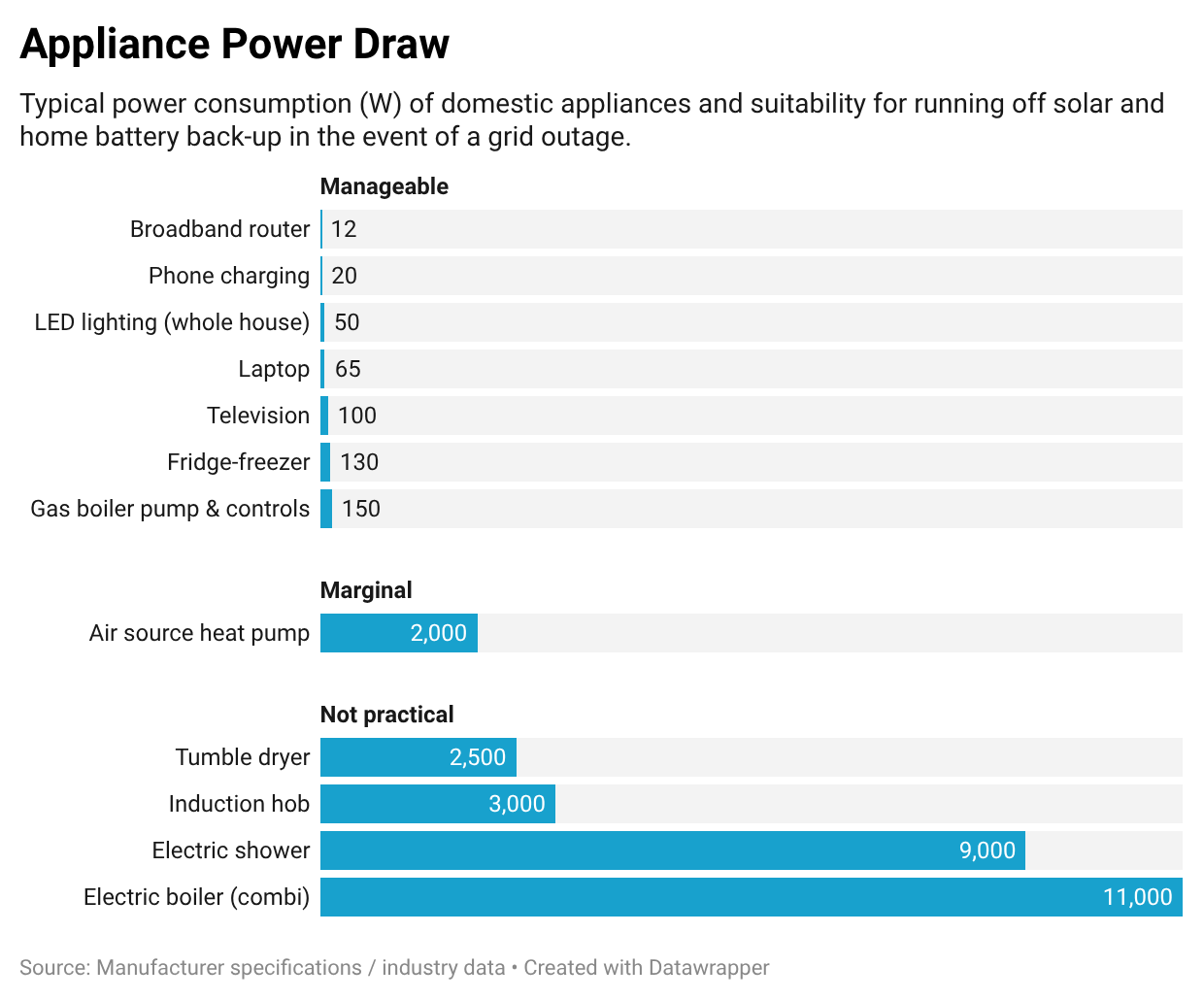 This is where realistic expectations matter. A 10kWh battery charged to 80% gives you roughly 8kWh of usable backup. Here’s how that gets used in practice:
The easy wins: a broadband router draws around 10 - 15W, a fridge-freezer around 100 - 150W, phone and laptop charging perhaps 100W combined. Running these essentials draws well under 400W, meaning 8kWh could sustain them for 20 hours or more. Connectivity, food safety, and keeping devices charged are entirely achievable.
The medium demands: a gas boiler’s pump and controls typically draw only 100 - 200W, so keeping the heating circulating through a gas central heating system is very manageable. An electric combi boiler is a different matter, using 9 - 12kW when heating water which is far beyond what most backup configurations can sustain continuously.
The heavy loads: air source heat pumps typically draw 1 - 3kW in operation, which is manageable for shorter periods but will drain a 10kWh battery in a few hours if running frequently. Electric showers (8–10kW), induction hobs, electric ovens and kettles, and tumble dryers are effectively off the table during backup operation unless there is sufficient battery capacity.
EV charging: most hybrid systems can continue EV charging from the battery during a short outage if configured to do so, though at a reduced rate.
The practical approach most households take is to configure backup power around a dedicated essential loads circuit: the fridge-freezer, broadband router, key sockets for devices, and boiler controls. That’s the combination that keeps daily life running through most realistic outage scenarios.
The Honest Summary
For most UK homeowners, a power cut with solar installed is identical to one without: the fridge starts warming, the router goes down, and you wait for the DNO to restore supply. That is not a failing, it is safety legislation doing its job, and the UK grid is reliable enough that most households will experience it only a handful of times over the life of their system.
If backup power genuinely matters to you whether for medical reasons, a dependency on home working, or simply peace of mind then you need a hybrid inverter system with EPS wiring properly installed. Specify it explicitly when getting quotes, confirm whether the system proposed supports whole-home or essential-circuit backup, and make sure the gateway hardware is included in the price, not assumed.
Solar won’t automatically keep your essentials running in a power cut. But with the right system, it absolutely can.
👉 Use our Battery Sizing Calculator to find the right size battery for your home