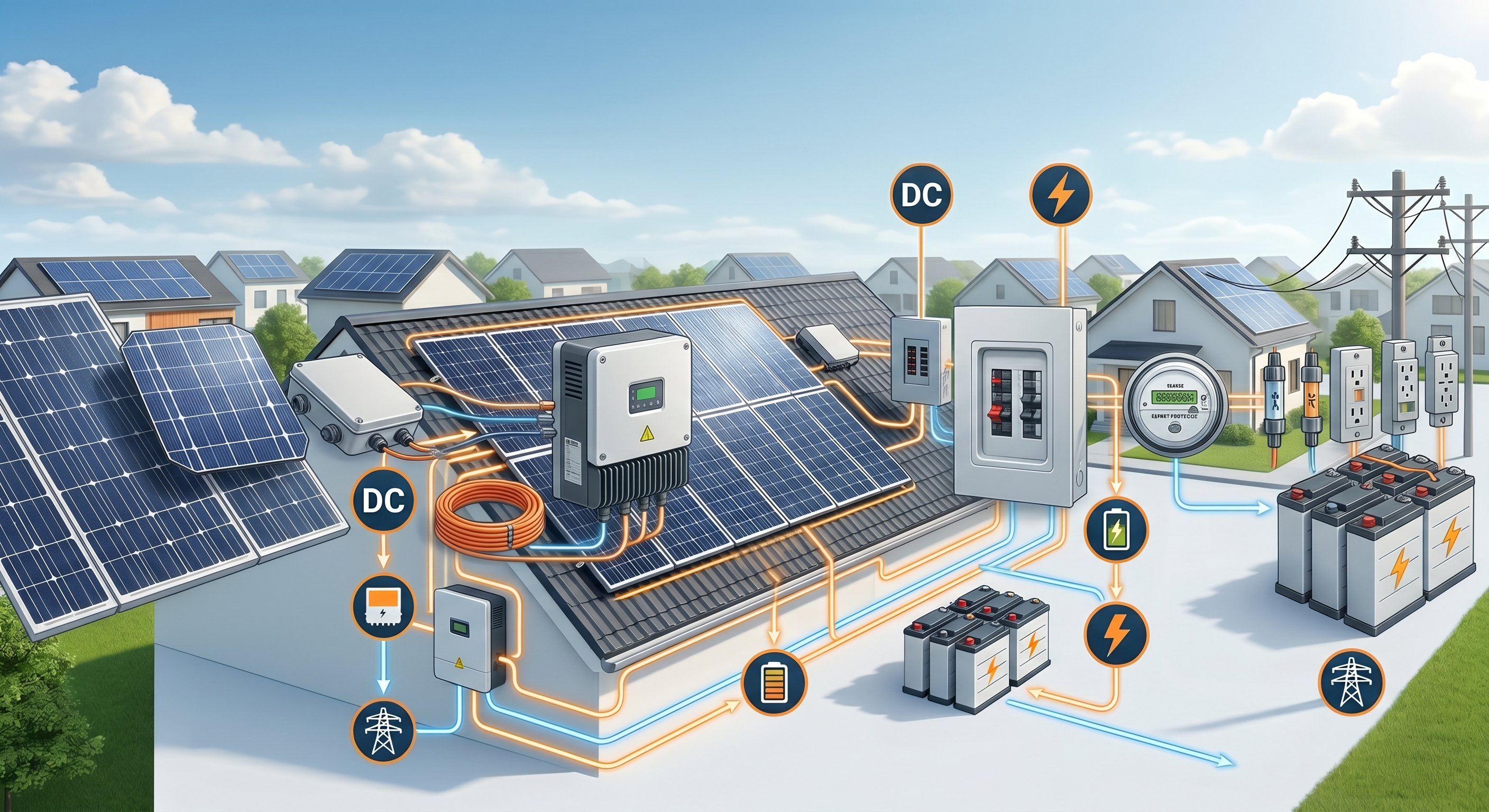
Getting quotes for solar panels means encountering a lot of unfamiliar terms quickly. Installers use them fluently, brochures take them for granted, and it can feel awkward to keep asking. This glossary covers every term you are likely to come across, in plain English, with no assumed knowledge.
Use it as a reference before speaking to installers, while reviewing quotes, or when reading through your system documentation after installation.
A
AC (Alternating Current) The type of electricity that flows through your home’s wiring and powers your appliances. The grid supplies AC electricity, and your solar system’s inverter converts the DC electricity generated by the panels into AC before it reaches your home. See also: DC, Inverter.
Anti-islanding protection A safety feature built into every grid-tied solar inverter. When the electricity grid goes down, the inverter automatically shuts off within a fraction of a second to prevent your solar system from sending electricity onto the network while engineers are working on it. Required by UK law. See also: EPS, Grid-tied system.
Array The complete set of solar panels installed on your roof, connected together. A solar array is the collection of individual panels that makes up your system. The size of your array determines your system’s total capacity in kWp.
B
Balance of system (BoS) All the components of a solar installation other than the panels themselves. This includes the inverter, mounting frames, cabling, fuses, and DC isolator switches. When comparing quotes, it is worth checking what balance-of-system components are included, as quality varies.
Battery capacity The total amount of energy a home battery can store, measured in kilowatt hours (kWh). A 10kWh battery can theoretically store 10kWh of electricity, though the usable capacity is usually slightly lower due to the battery management system reserving a buffer to protect battery health. See also: kWh, Usable capacity.
Battery management system (BMS) The control system inside a home battery that manages charging, discharging, temperature, and overall battery health. A good BMS prevents overcharging and deep discharging, which would shorten the battery’s lifespan.
Bifacial panels Solar panels that can generate electricity from both their front and rear surfaces. The rear side captures reflected light from the roof or ground beneath the panel. Bifacial panels can generate modestly more electricity than standard panels on the same roof, particularly on light-coloured or reflective surfaces.
Building regulations Most solar panel installations in England and Wales are covered by permitted development rights and do not require planning permission, though they do require compliance with building regulations for the electrical installation. Your MCS-certified installer will handle this. Listed buildings and properties in conservation areas have additional restrictions.
C
Carbon payback period The time it takes for a solar system to generate as much energy as was used to manufacture and install it. For UK rooftop solar, this is typically two to three years. After that point, every unit generated represents a genuine net reduction in carbon emissions.
Consumer unit (fuse board) The electrical distribution board in your home that contains circuit breakers for each electrical circuit. Your solar system connects to the consumer unit, which distributes the generated electricity around your home. Older fuse boards may need upgrading as part of a solar installation.
D
DC (Direct Current) The type of electricity that solar panels generate. DC electricity flows in one direction, unlike AC which alternates. Your inverter converts DC from the panels into AC for use in your home. Some battery systems store electricity as DC, making the DC-to-AC conversion more efficient in systems where the battery is DC-coupled. See also: AC, Inverter, DC-coupled.
DC-coupled battery A battery system that connects to your solar panels before the inverter, storing electricity as DC without first converting it to AC. This can be more efficient than AC-coupled systems because it avoids multiple conversion steps. The Tesla Powerwall 3 and Sigenergy SigenStor are examples of DC-coupled systems. See also: AC-coupled battery.
AC-coupled battery A battery that connects to the AC side of your system, after the inverter. AC-coupled batteries can often be retrofitted to an existing solar installation without replacing the inverter, which makes them a practical option for adding storage to an older system. They involve an extra conversion step compared to DC-coupled batteries, which carries a small efficiency penalty.
Degradation rate The rate at which a solar panel’s output declines over time due to gradual wear on the photovoltaic cells. Most modern panels degrade at around 0.3 to 0.5% per year. A panel rated at 0.5% annual degradation will still produce around 87% of its original output after 25 years. Reputable manufacturers specify the degradation rate in their performance warranty.
DNO (Distribution Network Operator) The company responsible for maintaining the electricity network in your area and distributing power to your home. There are several DNOs across the UK covering different regions, including UK Power Networks, National Grid Electricity Distribution, Northern Powergrid, Electricity North West, SP Energy Networks, and Scottish and Southern Electricity Networks. When you install solar, your installer must notify your DNO through the G98 or G99 process. See also: G98, G99.
Dual-rate meter See: Smart meter, Economy 7.
E
Economy 7 An older two-rate electricity tariff that offers cheaper electricity during seven off-peak hours overnight, typically between midnight and 7am. Economy 7 was originally designed for storage heaters. It can be used for overnight battery charging but has largely been superseded by more flexible smart tariffs for solar households. See also: Time-of-use tariff.
EPC (Energy Performance Certificate) A rating from A to G that assesses the energy efficiency of a property. Solar panels typically improve a home’s EPC rating by one to two bands, depending on the existing rating and system size. A higher EPC rating matters for rental properties (minimum E currently required for new tenancies), mortgage applications, and resale value.
EPS (Emergency Power Supply) The feature that allows a hybrid battery system to continue supplying electricity to your home during a grid power cut. When the grid fails, the system isolates your home and runs from the battery and, if available, from your solar panels. EPS requires specific hardware beyond just a battery and inverter. Not all battery systems include it. See also: Anti-islanding protection, Island mode.
Export meter A meter that records how much electricity your solar system sends back to the grid. You need an export meter registered with your supplier to receive Smart Export Guarantee payments. Most smart meters can function as export meters with half-hourly reading capability. See also: Smart Export Guarantee, MPAN.
F
Feed-in Tariff (FiT) A government scheme that ran from 2010 to 2019, paying solar panel owners a guaranteed rate for electricity generated and exported. The FiT closed to new applicants in March 2019 but existing recipients continue to receive payments. It was replaced by the Smart Export Guarantee. See also: Smart Export Guarantee.
Flat-rate tariff A standard electricity tariff that charges the same price per unit regardless of the time of day. Under the current Ofgem price cap, the flat rate is around 24 to 25p per kWh. Households with solar and batteries often benefit from switching to a time-of-use tariff. See also: Time-of-use tariff, Ofgem price cap.
G
G98 The process for connecting a small solar system to the grid without prior approval, used for most standard domestic installations with a single-phase inverter output up to 3.68kW. Under G98, your installer notifies the DNO after installation rather than applying in advance. Free to register. See also: G99, DNO.
G99 The process for connecting a larger solar system to the grid, required when the inverter output exceeds 3.68kW on a single-phase supply, or for three-phase systems above certain thresholds. Unlike G98, G99 requires the DNO to approve the connection before installation can take place, which can add eight to twelve weeks to the project timeline. DNOs charge a fee for G99 applications, typically between £300 and £750. See also: G98, DNO.
Generation meter A meter that records the total electricity your solar system generates, regardless of whether it is used in the home or exported to the grid. Required by some tariffs and useful for monitoring system performance.
Grid-tied system A solar installation that is connected to the public electricity grid. The vast majority of UK domestic solar systems are grid-tied. A grid-tied system automatically shuts down during a power cut due to anti-islanding protection. To have backup power during an outage, you need a hybrid system with EPS capability. See also: Anti-islanding protection, EPS, Hybrid inverter.
Ground-mounted solar Solar panels installed on a frame on the ground rather than on a roof. Ground-mounted systems can be positioned for optimal orientation and pitch, and are not subject to roof weight or structural constraints. They typically require permitted development consent or planning permission and are more common on rural properties with available land.
H
Half-hourly metering Smart meter data recorded in 30-minute intervals rather than as a single daily total. Half-hourly metering is required to access time-of-use tariffs, Smart Export Guarantee variable rate payments, and smart battery charging schedules. Most smart meters installed in the UK can provide half-hourly data on request. See also: Smart meter, Time-of-use tariff.
Hybrid inverter An inverter that can manage both solar panels and a battery storage system, as well as the grid connection. Hybrid inverters are the standard choice for new solar and battery installations. They are distinct from standard string inverters, which manage solar generation only. Some hybrid inverters also include EPS capability for backup power. See also: Inverter, EPS, String inverter.
I
Inverter The central component of a solar system that converts DC electricity from the panels into AC electricity for use in your home. Inverters also manage the connection to the grid, including shutting down during a power cut. There are three main types: string inverters (one central unit for all panels), microinverters (one per panel), and hybrid inverters (which also manage battery storage). See also: String inverter, Microinverter, Hybrid inverter, DC, AC.
Island mode See: EPS.
Irradiance The intensity of solar energy reaching a surface at a given moment, measured in watts per square metre (W/m²). Peak irradiance in the UK on a clear summer day might reach around 1,000 W/m². Average annual irradiance varies by region and is the primary factor behind regional differences in solar generation. See also: kWp, PVGIS.
K
kW (Kilowatt) A unit of power equal to 1,000 watts. It describes how much electricity is being generated or consumed at a given instant. A 3kW solar system generates up to 3kW of electricity at its peak output. Not to be confused with kWh. See also: kWh, kWp.
kWh (Kilowatt hour) A unit of energy equal to one kilowatt of power used or generated for one hour. It is the unit on your electricity bill. A 3kW solar system running at full output for two hours generates 6kWh. Annual solar generation and household electricity consumption are both measured in kWh. See also: kW, kWp.
kWp (Kilowatt peak) The rated maximum output of a solar system under standard test conditions: full, direct sunlight at 25°C, with no shading or losses. It is the headline figure used to describe system size. A 4kWp system will rarely achieve exactly 4kW in real-world conditions, but kWp is a consistent basis for comparing systems. In the UK, 1kWp typically generates around 850 to 1,050kWh per year depending on location and orientation. See also: kW, kWh.
L
Levelised cost of energy (LCOE) The average cost per unit of electricity generated by a solar system over its lifetime, calculated by dividing the total cost of installation and maintenance by the total units generated. Solar’s LCOE has fallen dramatically over the past decade and is now competitive with or below grid electricity prices for many UK households.
Load shifting Deliberately changing when you use high-consumption appliances to make better use of solar generation or cheap off-peak electricity. Running the dishwasher, washing machine, or EV charger during peak solar generation hours rather than in the evening is a straightforward form of load shifting that increases self-consumption without requiring any additional hardware.
M
MCS (Microgeneration Certification Scheme) The industry standard that certifies solar panel installers and products in the UK. An MCS-certified installation is a requirement for accessing the Smart Export Guarantee and for any work to qualify under government grant schemes. Always check that an installer holds current MCS certification before signing a contract. You can verify this at mcscertified.com. See also: Smart Export Guarantee.
Microinverter A small inverter attached directly to the back of each individual solar panel, rather than a single central unit for all panels. Because each panel operates independently, shading or underperformance on one panel does not affect the others. Microinverters cost more than string inverters but are better suited to roofs with partial shading or multiple orientations. See also: Inverter, String inverter, Power optimiser.
Monitoring system Software and hardware that tracks the real-time and historical performance of your solar system. Most modern inverters include built-in monitoring via an app or web portal. Third-party monitoring platforms such as PVOutput and Home Assistant integrations can provide additional detail. Monitoring helps you identify faults, track savings, and optimise battery charging schedules.
MPAN (Meter Point Administration Number) A 21-digit number that uniquely identifies your electricity supply point. Your import MPAN identifies the electricity coming into your home. If you export to the grid and receive SEG payments, you may also need a separate export MPAN registered with your supplier. Found on your electricity bill. See also: Smart Export Guarantee, Export meter.
O
Ofgem The Office of Gas and Electricity Markets. The UK regulator for the energy industry. Ofgem sets the energy price cap that limits what suppliers can charge per unit of electricity for customers on default tariffs. It also oversees the Smart Export Guarantee scheme and publishes guidance on solar and battery installations. See also: Ofgem price cap, Smart Export Guarantee.
Ofgem price cap The maximum rate that energy suppliers can charge per unit of electricity and gas for customers on standard variable tariffs. Updated quarterly. The current cap (Q2 2026) sets electricity at 24.67p per kWh. The price cap directly affects solar payback calculations because the higher the cap, the more each unit of self-consumed solar is worth. See also: Ofgem.
Off-peak rate The cheaper electricity rate available during low-demand periods, typically overnight, on a time-of-use tariff. Off-peak rates on tariffs such as Intelligent Octopus Go are currently around 8p per kWh between 11:30pm and 5:30am, compared to around 24 to 25p during the day. Charging a battery overnight at the off-peak rate and using it during the day is one of the primary financial benefits of home battery storage. See also: Time-of-use tariff, Peak rate.
Optimiser See: Power optimiser.
P
Payback period The number of years it takes for the cumulative financial savings from a solar system to equal the upfront cost of installation. Payback periods for a typical UK solar installation currently range from around 9 to 12 years for a panel-only system, and 10 to 14 years for a solar and battery system, depending on usage, tariff, and system size. The system continues generating savings for the remainder of its 25-year-plus lifespan after payback. See also: ROI.
Peak rate The higher electricity rate charged during periods of high demand, typically the late afternoon and early evening, on a time-of-use tariff. Peak rates on some tariffs can reach 35p per kWh or more between 4pm and 7pm. A battery charged cheaply overnight or from free solar generation and discharged during the peak window maximises bill savings. See also: Time-of-use tariff, Off-peak rate.
Performance warranty A manufacturer guarantee that a solar panel will maintain a minimum output level over a specified period, typically 25 years. Distinct from the product warranty, which covers physical defects. A common performance warranty guarantees no more than 0.5% annual degradation and at least 80% output after 25 years. See also: Product warranty, Degradation rate.
Photovoltaic (PV) The technology by which solar panels convert sunlight into electricity. The photovoltaic effect was discovered in 1839. In everyday use, “solar PV” refers to electricity-generating panels, as distinct from solar thermal panels, which generate heat rather than electricity.
Power optimiser A device attached to each individual solar panel that maximises that panel’s output independently of the others. Power optimisers work with a central string inverter, offering better performance on shaded or complex roofs than a standard string inverter setup, while costing less than a full microinverter installation. SolarEdge is the market leader in power optimiser systems. See also: Microinverter, String inverter.
Product warranty A manufacturer guarantee covering physical defects in a solar panel, such as delamination, cracking, or frame damage. Most reputable manufacturers offer a 10 to 15 year product warranty. Distinct from the performance warranty, which covers output levels over time. See also: Performance warranty.
PVGIS (Photovoltaic Geographical Information System) A free online tool from the European Commission’s Joint Research Centre that estimates the annual solar energy output for any location in Europe based on historical irradiance data. Useful for checking installers’ generation estimates against an independent source. Available at re.jrc.ec.europa.eu/pvg_tools.
R
ROI (Return on Investment) A measure of the financial return from a solar installation expressed as a percentage of the initial cost. A system that costs £7,000 and saves £700 per year delivers a 10% annual return on investment. Solar ROI calculations should account for electricity price inflation over the system’s lifetime, which can substantially improve the headline figure. See also: Payback period.
Roof-integrated panels Solar panels designed to replace roof tiles rather than sitting on top of them, giving a flush appearance. Also called building-integrated photovoltaics (BIPV). Products such as the Tesla Solar Roof fall into this category. Roof-integrated panels are more expensive than standard mounted panels and output per square metre is typically lower, but they are preferred in settings where aesthetics are a priority or where standard panels might face planning objections.
S
Self-consumption The proportion of your solar generation that your household uses directly, rather than exporting to the grid. Higher self-consumption generally means greater financial benefit, since using your own electricity saves around 24 to 25p per unit compared to the 10 to 15p you would earn from export. Adding a battery significantly increases self-consumption by allowing you to use solar electricity in the evening.
SEG See: Smart Export Guarantee.
Smart Export Guarantee (SEG) The UK government scheme, launched in January 2020, that requires large energy suppliers to pay solar panel owners for surplus electricity exported to the grid. Unlike the older Feed-in Tariff, the SEG does not specify a rate: suppliers set their own export rates competitively. Rates currently range from around 5p to 20p per kWh depending on the supplier and tariff type. An MCS-certified installation and a smart meter are required to register. See also: Feed-in Tariff, MCS, Smart meter.
Smart meter A digital electricity meter that communicates usage and export data to your supplier automatically, without manual readings. Smart meters record consumption and generation in half-hourly intervals, which is necessary for time-of-use tariffs and SEG variable export payments. Most UK homes now have a smart meter or can request one from their supplier at no charge. See also: Half-hourly metering, MPAN.
Solar thermal A technology that uses sunlight to heat water directly, rather than generating electricity. Solar thermal panels feed a hot water cylinder and are distinct from solar PV panels. The two systems use different components and serve different purposes. This site focuses on solar PV.
Standing charge The daily fixed cost on your electricity bill, charged regardless of how much electricity you use. Standing charges currently average around 61p per day across UK suppliers. Switching to a time-of-use tariff to benefit from cheap overnight charging does not eliminate the standing charge.
String inverter The most common and most affordable type of solar inverter. All panels connect in a series to a single central inverter unit. String inverters work well on simple, unshaded roofs with panels all facing the same direction. If one panel in the string is shaded or underperforming, it can reduce the output of the others. See also: Microinverter, Power optimiser, Hybrid inverter.
T
Time-of-use tariff (ToU) An electricity tariff that charges different rates at different times of day, typically lower overnight and higher during evening peak periods. Time-of-use tariffs are well-suited to solar and battery households because they enable cheap overnight battery charging and reward households that shift consumption away from peak periods. Examples include Intelligent Octopus Go and Agile Octopus. See also: Off-peak rate, Peak rate, Smart meter.
Three-phase supply A type of electricity supply used in some larger homes and properties, which provides three separate alternating currents rather than the single alternating current of a standard domestic supply. Three-phase supplies can handle higher power loads. If your home has a three-phase supply, your solar installer will need to account for this in system design, inverter selection, and DNO notification requirements.
U
Usable capacity The amount of energy in a home battery that can actually be drawn on during normal operation, after the battery management system reserves a buffer to protect cell health. A battery marketed as 10kWh may have a usable capacity of 9 to 9.5kWh. Most manufacturers now quote usable capacity directly, but it is worth confirming when comparing products. See also: Battery capacity, BMS.
V
VAT relief Solar panel installations currently attract 0% VAT rather than the standard 20% rate, under legislation in place until 31 March 2027. This applies to the full cost of a domestic solar installation including panels, inverter, mounting hardware, and battery storage. On a typical installation costing £7,000 to £8,000, this represents a saving of around £1,400 to £1,600 compared to the standard rate.
W
Warm Homes Plan The UK government’s £15 billion energy efficiency programme, launched in January 2026, which aims to upgrade up to 5 million homes by 2030. The plan includes the Warm Homes: Local Grant (up to £15,000 for eligible lower-income households towards solar and other energy improvements) and the forthcoming Warm Homes Fund (0% interest loans, expected to be fully operational in 2027). See also: ECO4.
Watt (W) The basic unit of electrical power. 1,000 watts equals one kilowatt (kW). A single solar panel might be rated at 400W, meaning it can produce up to 400 watts of electricity at peak output. See also: kW, kWh, kWp.
Terms and rates on this page are updated periodically to reflect current UK market conditions. If you spot anything that needs updating, get in touch.